Collection
Basic Knots By Gorgone
 Gorgone
In this class, Gorgone teaches the Single Column Tie and Double Column Tie, explains their different functions and when to use one to the other.
The only time full knots are used in shibari is to start a tie and create an anchor point onto a limb or a body part, for this we use two basic ties called Single Column Tie (SCT) and Double Column Tie (DCT). These knots are the most basic but also most important ones, they should be practiced until your hands are faster than your brain.
One of the most important thing when tying someone else is to make them feel that you can tie those first knots quickly and confidently so they can let go and enjoy. Ideally you should be able to do these basic ties without looking at your hands, so you can rely on muscle memory and focus on your partner rather than your knots.
If applied creatively to the body, these two knots and a few simple rope wrappings and shibari frictions are enough to create beautiful and playful ties!
* Captions available for this series : English, Spanish
Show moreShow less
5 videos
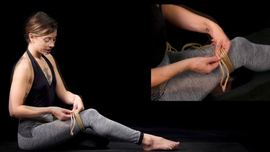 10:08
10:08Single-Column Tie
In-depth explanations of the Single Column Tie.
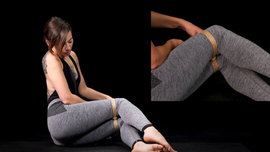 03:55
03:55Double-Column Tie
In-depth explanations for the Double Column Tie.
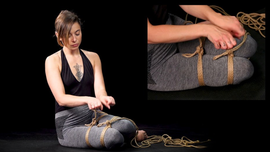 02:12
02:12When To Use SCT Or DCT?
Further explanation about the different functions and uses of the SCT and DCT.
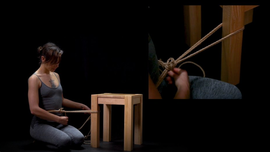 04:09
04:09Lock-Offs & Yuki Fix
Example of simple lock-off to attach a rope to a bed post or solid furniture.
 02:43
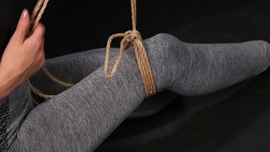
02:43All Basic Knots | Demo
Example of simple wraps and closing options after tying a SCT or DCT.
Comments on collection (13)
MašaDecember 3, 2021
I find that the somerville bowline also has a line that slips, much as the easy somerville that Gorgone showed in the video. Therefore both are imperfect. Is there a way to fix this?Show replies (2)

Anton (.October 30, 2023
Thanks for the question! It’s true that even in a regular Somerville Bowline you can get some slippage. The main difference between these two locking techniques is that, for the somerville bowline, the loop that collects the bight gets collapsed over top of the piece of rope that wants to slip around. By using rope with a decent amount of inherent friction in it and by firmly compacting your knot so that it distorts the cuff underneath it, rather than just sitting on top of the cuff, you can mitigate a lot of that slippage. When we do the fast bowline, the loop that collects the bight collapses on the opposite side of the cuff as the free running rope, so that rope is left to run through the cuff unblocked. The short answer to your question is: notice how much friction is/isn’t inherent in the type of rope you’re using (it will be harder to achieve this effect with nylon than with jute, for example). And make sure that your somerville knot is tidy and is collapsing in such a way that it bends the rope in the cuff below it.HenkJanuary 26, 2022
Good observation! The imperfection of the fast bowline compared to the somerville bowline is not the slipping line she shows in the video (as you mentioned both the somerville bowline and the fast bowline have a slipping line) but the fast bowline can become self tightening whereas the somerville bowline can't.
Virgiliu I.January 19, 2026
Is this course on the free tier? I want to share shibari studdy with friends, but I think they shoul be able to see at least a single column before deciding to pay
Show replies (1)

ShibariStudyJanuary 27, 2026
Yes! The single and double column tie videos in this collection are both free :)

MasonOctober 5, 2023
Lovely. Thank you.
Show replies (1)
Anton (.October 30, 2023
Thank you :)

Jules K.March 3, 2020
Really enjoyed this video, thank you. Was left with two questions if you have time. 1. Curious, what is the name of that 2nd knot? (After the double overhand knot.) 2. Am I mistaken or does the somerville bowline also have the same problem as the fast bowline, where two of the ropes can move independently beneath it?Show replies (1)

AndyApril 10, 2020
The second single column tie that Gorgone demonstrated is called a square knot or a reef knot. Once made, the Somerville bowline will cinch its wraps and prevent slipping. I check that those column wraps are tensioned and balanced properly. I like to ensure I can fit a couple of fingers under the wraps and check for any twists that could cause uneven pressure and unintended discomfort. I then secure the tie by compacting the knot while pulling firmly on the working end I'll use to continue tying. That tension secures the wraps beautifully.
mrDodgsonApril 5, 2022
Is there a reason the DCT is locked with just an overhead knot insteed of a summerville bowline (like showed on the SCT)? Also, are there any objections using a lark's head + half hitch on a SCT?HenkJanuary 26, 2022
For the lock offs, you should look into the sliding sheet bend, I find it very usefull as a lock off as it can be tied within 5 seconds and untied within a second.Meghan R.August 4, 2021
Thank you, Gorgone. What I took away from this is a Somerville bowline is the way to go and I've got it down pat.Dusan R.September 5, 2020
Maybe one important note to make as a distinction between the overhead knot and reef knot is the direction of the working end that you are left with. In the video: after overhead knot (double or not) a working end goes naturally to the inside, while with reef knot a working end points to the outside.


